
Claude AI 4.7 Now Available on App Store [APK Download]

Subscribe for Updates
Anthropic recently introduced Claude 4.7 Opus, the latest addition to their impressive lineup of AI language models. This release is directly competing with OpenAI’s ChatGPT 5 and Google’s Gemini AI 3.1 Pro. According to reports, Claude AI is better than ChatGPT and Gemini Pro in most cases. Especially in coding with the new Claude 4.7 and Artifacts feature. Claude AI mobile app is now available for download on the Play Store for Android and Apple App Store for iPhones.
The release of Claude 4.7 Sonnet has high intelligence, faster performance, and advanced capabilities across text, code, and vision. This model even has business-centric features like enhancing customer support and accelerating software development via code co-pilot and facilitating team collaboration.
Claude Opus 4.7 — Overview and features
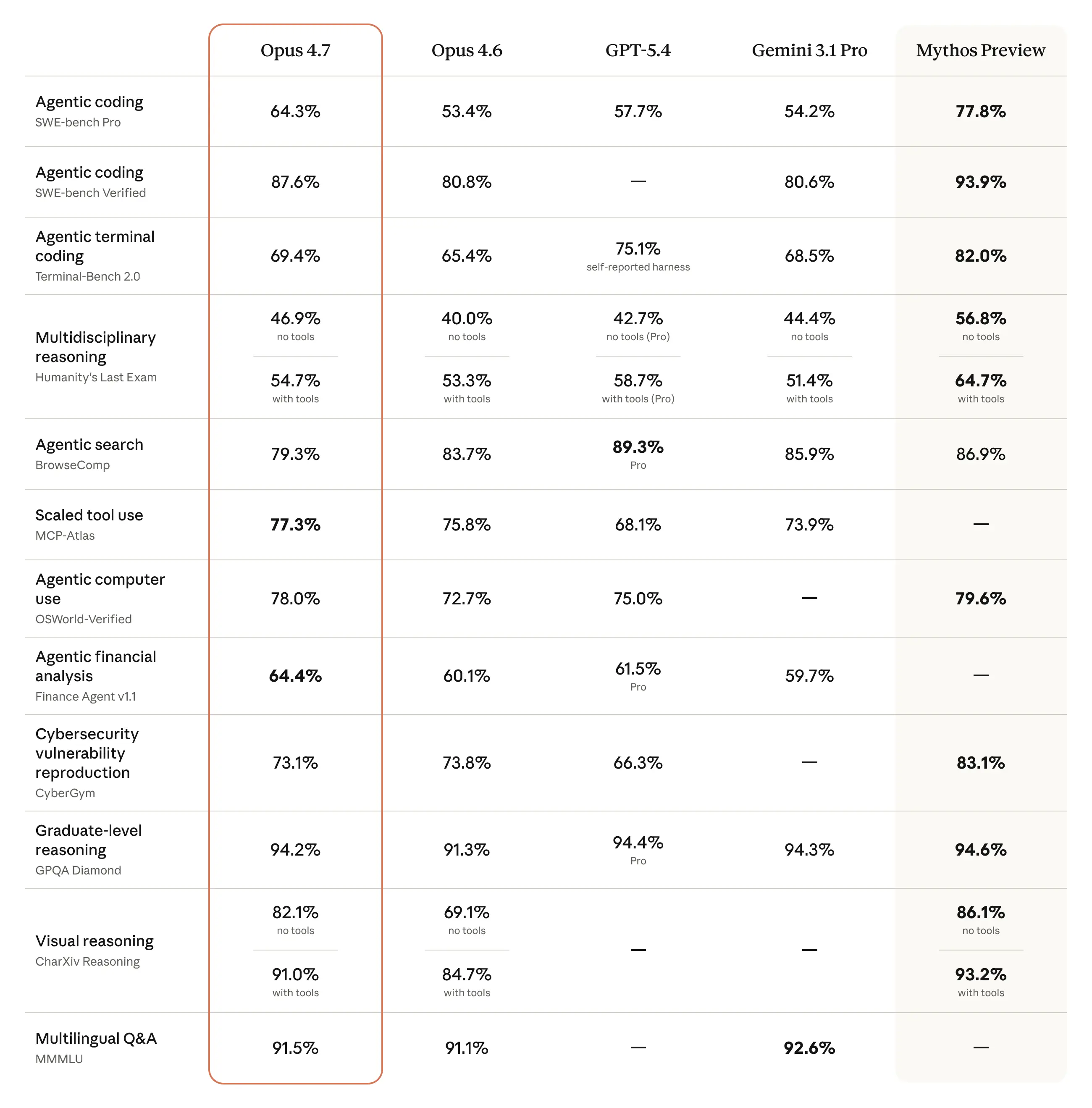
Anthropic released Claude Opus 4.7 as a general-availability upgrade focused on advanced software engineering, long-horizon reasoning, and higher-fidelity vision. The company positions Opus 4.7 as a direct upgrade to Opus 4.6 with measurable gains on the hardest coding and multi-step agentic tasks, and it is available across Anthropic’s Claude products, App Stores, and major cloud marketplaces.
What’s new under the hood — technical improvements that matter
Stronger coding and long-context reasoning. Opus 4.7 shows a meaningful lift on internal coding benchmarks, resolving more difficult tasks and reducing tool errors in multi-step workflows. Anthropic reports a double-digit improvement on several coding and agentic evaluations, and testers describe it as more autonomous and better at catching its own logical faults during planning.
Better instruction following and opinionated reasoning. The model follows instructions more literally and reliably than prior Opus releases, which means prompts written for older models may need retuning. This stricter instruction following improves correctness on complex tasks but can change how previously working prompts behave.
Higher-effort control for hard problems. Opus 4.7 introduces an xhigh effort level between high and max, giving developers finer control over the tradeoff between reasoning depth and latency. Anthropic recommends starting with high or xhigh for coding and agentic workloads.
Multimodal and vision upgrades — what you can do with images now
Higher-resolution image understanding. Opus 4.7 accepts images up to 2,576 pixels on the long edge, roughly 3.75 megapixels, more than three times the resolution supported by prior Claude models. This unlocks use cases that require pixel-level detail such as dense screenshots, technical diagrams, chemical structures, and life-sciences patent workflows. Because higher-resolution images consume more tokens, Anthropic recommends downsampling when the extra detail is unnecessary.
Improved multimodal reasoning. Early testers report stronger performance on tasks that combine visual and textual reasoning, including document analysis, diagram interpretation, and visual debugging workflows. These gains make Opus 4.7 a better fit for agents that must read and act on complex visual inputs.
Safety, cyber safeguards, and the Cyber Verification Program
Targeted cyber safeguards. Anthropic intentionally released Opus 4.7 with automated safeguards that detect and block requests indicating prohibited or high-risk cybersecurity uses. The company used Opus 4.7 as the first model to test new cyber protections before broader Mythos-class releases. Security professionals who need legitimate cybersecurity capabilities are invited to join Anthropic’s Cyber Verification Program for vetted access.
Alignment and safety profile. Opus 4.7 shows a safety profile similar to Opus 4.6 with improvements on some measures such as resistance to prompt injection and honesty, while other measures show modest regressions. Anthropic’s system card and evaluations provide the detailed tradeoffs and the company emphasizes that Mythos Preview remains the most strongly aligned model in their lineup.
Migration guidance, pricing, and developer recommendations
Availability and pricing. Opus 4.7 is available across the Claude product family and via the API, Amazon Bedrock, Google Cloud Vertex AI, and Microsoft Foundry. Pricing is unchanged from Opus 4.6 at $5 per million input tokens and $25 per million output tokens. anthropic.com
Tokenizer and token usage. Opus 4.7 uses an updated tokenizer that can increase input token counts by roughly 1.0–1.35× depending on content. The model also tends to produce more output tokens at higher effort levels because it “thinks more” during long runs. Anthropic recommends measuring token usage on real traffic and using the new task budgets feature to control token spend for long-running tasks. anthropic.com
Practical tuning tips.
- Retune prompts that were written for Opus 4.6 to avoid unexpected literal behavior.
- Start with high or xhigh effort for complex coding or agentic tasks and adjust down if latency or token cost is a concern.
- Use task budgets to cap token spend on long workflows and instruct the model to be concise when cost matters.
- Downsample images when you don’t need pixel-perfect detail to save tokens.
Real-world use cases and who benefits most
Engineering and code review. Teams shipping complex systems, CI/CD automations, and long-running debugging workflows will see the biggest productivity gains. Opus 4.7’s improved loop resistance, error recovery, and ability to carry work through tool failures make it well suited for autonomous code tasks and code review automation.
Finance, legal, and enterprise document work. Internal evaluations show stronger document reasoning and finance analysis, producing more rigorous models and professional outputs for presentations and reports. Enterprises that rely on multi-step document workflows can expect fewer errors and more consistent results.
Multimodal product workflows. Product teams building dashboards, data-rich interfaces, or tools that analyze screenshots and diagrams will benefit from the higher-resolution vision and improved multimodal reasoning. Designers and analysts can use Claude Design and the upgraded vision to generate polished visual work and prototypes.
Download Claude App
Claude AI app is already available on the App Store for iPhones. The Claude 4.7 app is rolling out on the Play Store for Android phones via beta channel. However, it’s only available in select countries. We will list the APK below soon. So stay tuned.
Meanwhile, visit the Play Store link and sign up for beta and download from the Play Store link below. Copy and paste the link in browser.
- Beta testing
- https://play.google.com/apps/testing/com.anthropic.claude
- Stable
- https://play.google.com/store/apps/details?id=com.anthropic.claude
Claude AI for iPhones from Apple App Store
Meet Expressive Launcher — A Fresh Way to Android
The wait is over. Expressive Launcher has graduated from beta and is now stable and available to everyone on the Google Play Store. Download it today and experience a fresh way to customize your Android home screen.
Get started
