
Would you buy a ChatGPT Phone? OpenAI’s Upcoming AI Agent Phone


Subscribe for Updates
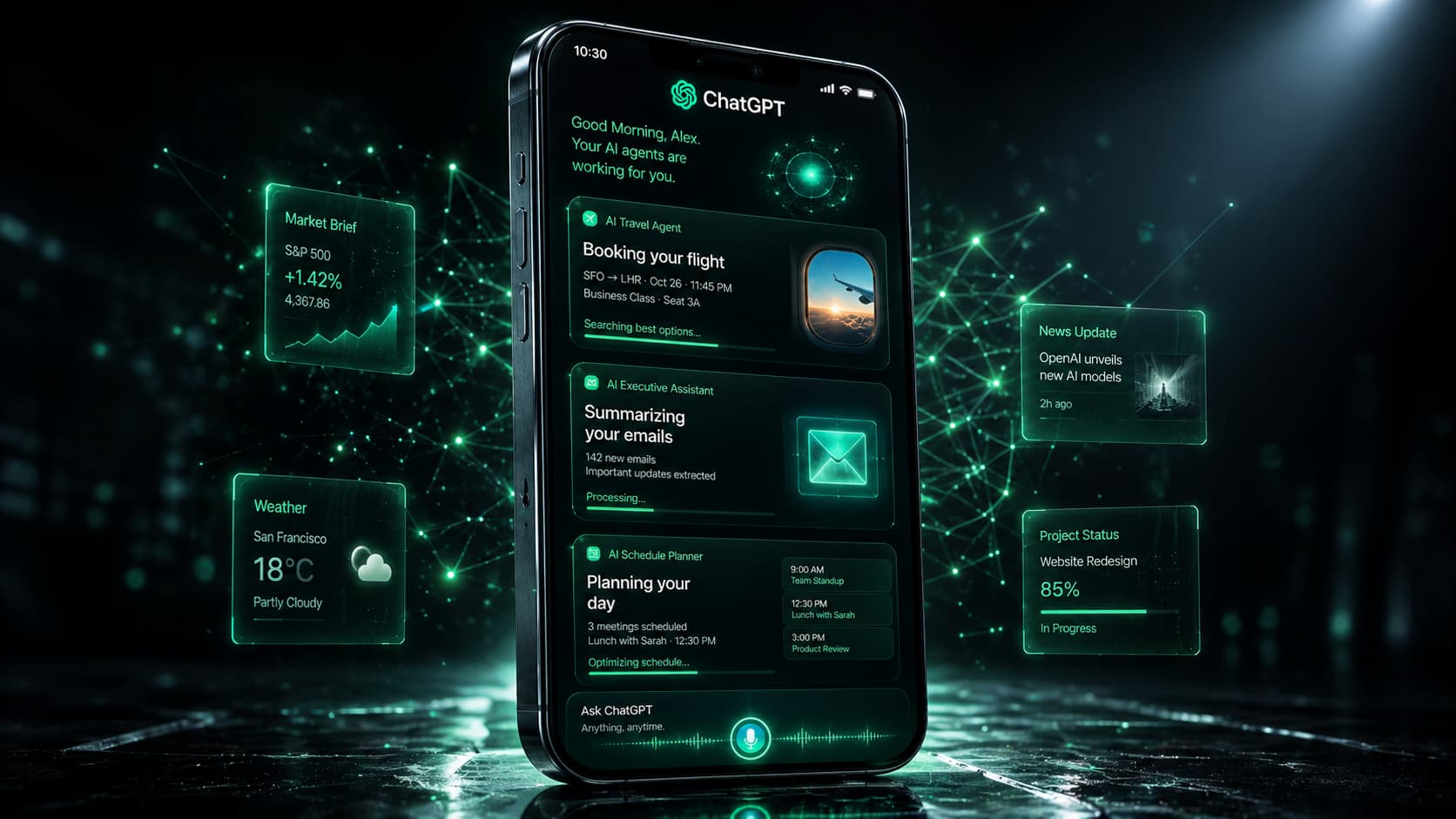
The smartphone has gone largely unchanged in its fundamental design philosophy for nearly two decades. You unlock it, tap an app, complete a task, close it, open another. Repeat. But according to a detailed industry analysis, that paradigm may be on the verge of a seismic shift — and OpenAI may be working on an AI agent first smartphone.
The rumor mill is churning again — and this time, it’s a big one. Prominent Apple supply chain analyst Ming-Chi Kuo dropped a detailed post on Twitter, claiming that OpenAI is actively working with chipmakers MediaTek and Qualcomm to develop custom smartphone processors, with Chinese manufacturer Luxshare lined up as the exclusive assembly and co-design partner. Mass production, if everything goes to plan, is targeted for 2028.
It’s the kind of headline that generates instant buzz. OpenAI, the company behind ChatGPT, is making a phone. The AI company to end all AI companies is now going after Apple and Samsung on their home turf.
But before we get swept up in the hype cycle, it’s worth slowing down and asking some hard questions. Because if you look closely, this story has more holes than a 2007 startup pitch deck.
What is an AI Agent phone?
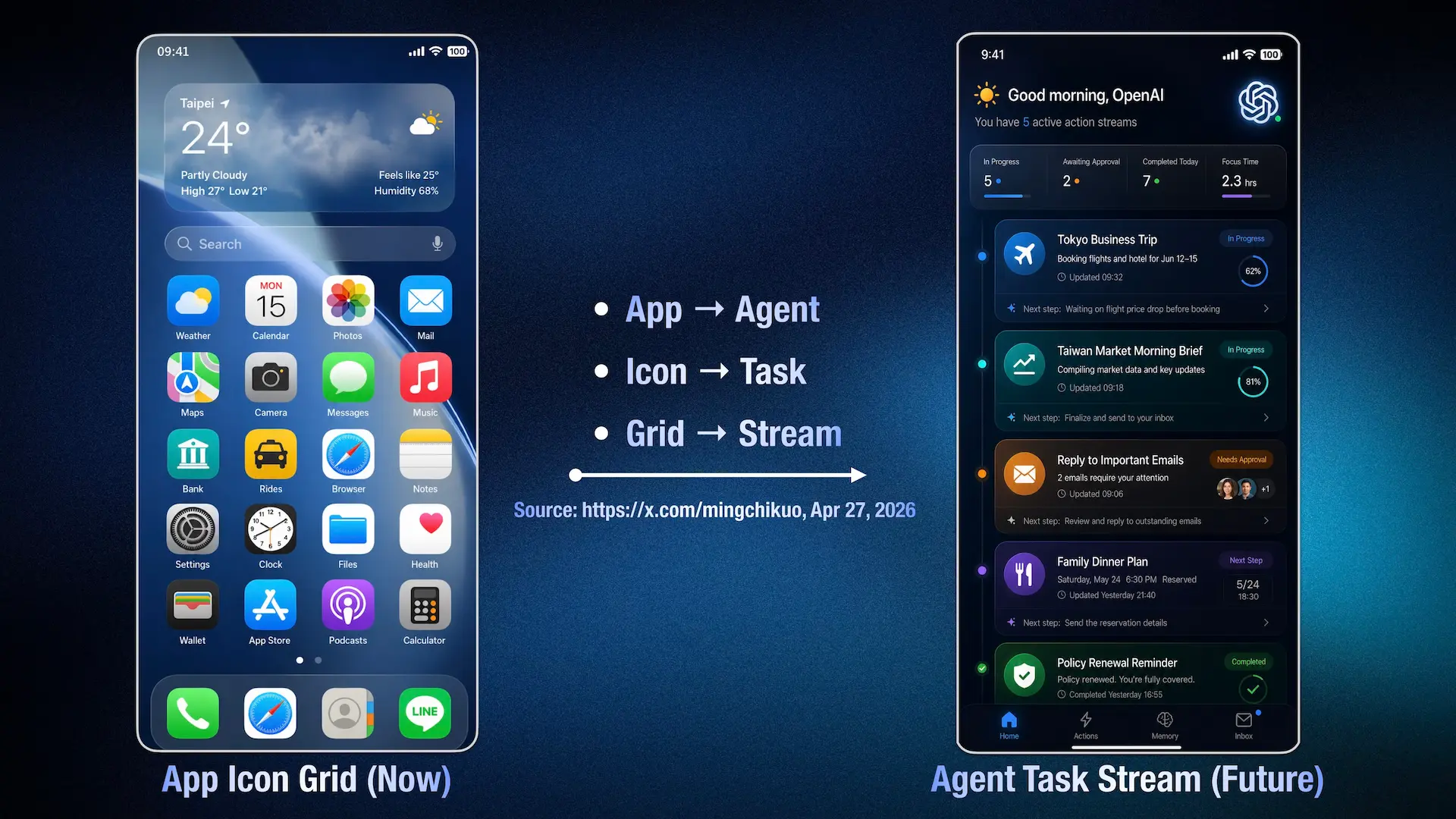
An AI Agent phone doesn’t rely on traditional apps or an app store. Instead, it uses AI to perform tasks on your behalf or dynamically create custom apps tailored to your needs.
The main argument is that when you pick up your phone to book a flight, you don’t want to open a browser, search for flights, switch to a booking app, enter your details, jump to your banking app to authorize payment, and then screenshot your confirmation into a notes app. You want to say, “Book me a flight to certain place next Friday under $200,” and have it done.
That’s the fundamental insight driving OpenAI’s smartphone ambitions. As Kuo puts it, “Users are not trying to use a pile of apps. They are trying to get tasks done and fulfill needs through the phone.” This isn’t just a product tweak — it’s a complete rethinking of what a smartphone is for.
Kuo’s thesis rests on a genuinely interesting insight: that people don’t use smartphones to run apps — they use them to get things done. The app model, he argues, is just an awkward intermediary layer between human intent and human outcome. An AI agent phone, in theory, collapses that layer entirely.
His reasoning for why OpenAI specifically would want to build the hardware breaks down into three points:
- Full-stack control: You can’t deliver a truly comprehensive AI agent experience if Apple or Google controls the OS and decides what your software can and cannot access.
- Real-time context: The smartphone is the only device that continuously captures your complete personal data picture — location, communications, health, finance, behavior. That data is the fuel for meaningful agent inference.
- Scale: Smartphones aren’t going away. Billions of users, hundreds of millions of high-end device sales annually, multi-year replacement cycles. The commercial opportunity is enormous.
The Hardware Architecture: Cloud + On-Device AI
A Hybrid Intelligence Model
One of the most technically interesting aspects of Kuo’s analysis is the description of a tightly integrated cloud and on-device AI architecture. This isn’t simply “ChatGPT on a phone” — it’s a fundamentally new compute model designed around continuous contextual understanding.
On-Device Responsibilities:
- Continuous context monitoring (always listening, always aware)
- Power-efficient execution of smaller models
- Memory hierarchy management for fast, local inference
- Basic task routing and intent classification
Cloud AI Responsibilities:
- Complex, compute-intensive reasoning
- Tasks requiring large model capabilities
- Cross-user data synthesis (anonymized and aggregated)
- Heavy multimodal processing
This split matters enormously for the processor design. It explains why OpenAI is co-developing custom chips with MediaTek and Qualcomm rather than simply licensing existing silicon. The requirements — sustained low-power context monitoring, efficient small-model execution, fast memory management — demand purpose-built architecture, not a general-purpose mobile SoC.
What the Processor Design Must Achieve
For this hybrid model to work seamlessly, the custom processor needs to solve several hard engineering problems simultaneously:
- Ultra-low power consumption for always-on context capture without draining the battery
- Efficient memory hierarchy to keep relevant user context accessible for rapid inference
- Dedicated neural processing optimized for small language and multimodal models
- Secure enclave architecture to protect sensitive personal data processed on-device
- High-bandwidth connectivity for seamless handoff between on-device and cloud AI
This is why the chip development timeline stretches to late 2026 or early 2027 for specifications, with mass production in 2028. These aren’t incremental improvements to existing designs — they represent a new category of mobile processor.
MediaTek and Qualcomm as Co-Development Partners
The choice of both MediaTek and Qualcomm as co-development partners is strategically interesting. Rather than picking one silicon champion, OpenAI appears to be hedging while also creating competitive pressure.
Kuo provides a striking comparison to put the commercial stakes in perspective. He notes that the revenue contribution of a single MediaTek × Google TPU “Zebrafish” chip is roughly equivalent to 30–40 AI agent smartphone processors. Given that the global high-end smartphone segment ships approximately 300–400 million units annually, successfully capturing even a fraction of that market would represent transformative revenue for whichever chip partner wins the production contract.
This mirrors the razor-and-blades logic of many hardware businesses, but with a twist: the “razor” (the phone) enables deeper engagement with the “blade” (the subscription AI service), which in turn generates the data flywheel that makes the AI better, which makes the subscription more valuable. It’s a potentially powerful compounding loop, if execution is flawless.
MediaTek, Qualcomm, and Luxshare
On the supply chain side, Kuo is bullish on MediaTek and Qualcomm as chip co-development partners, noting that a single AI agent smartphone processor could represent a fraction of the revenue equivalent of a specialized AI chip. And Luxshare, he argues, sees this as a once-in-a-generation opportunity to escape Hon Hai’s shadow Data?
Here’s the structural problem at the heart of the AI agent thesis that Kuo’s analysis glosses over: the businesses that hold the most useful data about you have absolutely no incentive to share it with an OpenAI agent.
Your bank, your insurer, your employer, your healthcare provider — they hold the private data and proprietary business logic that would make an AI agent genuinely powerful. None of them are going to donate that access to a third-party AI intermediary that could disrupt their customer relationships, create regulatory liability, or simply undercut their own digital products.
An AI agent that can only access the data you voluntarily feed it is a very limited AI agent. The vision Kuo describes — a phone that understands your “full real-time state” and acts as a comprehensive life orchestrator — requires data access that the current regulatory and commercial landscape simply does not permit, and that powerful incumbents will actively resist.
Why This Could Fail Spectacularly
The App Ecosystem Problem
One of the most consistently raised objections is the chicken-and-egg problem of app ecosystems. Developers aren’t going to rush to build for a phone that’s trying to replace apps. Without a robust app ecosystem, the OpenAI phone won’t be able to do many of the things people actually use smartphones for gaming, streaming, social media, and niche utilities.
Apple took years to build its App Store ecosystem, and Google took even longer to challenge it meaningfully. OpenAI in 2028 would be starting from zero in a market where iOS and Android have hundreds of thousands of mature apps and deeply entrenched developer communities.
The Differentiation Problem
What will an OpenAI phone do in 2028 that an iPhone with deep ChatGPT integration won’t already do? Apple is being compelled — through regulatory pressure and competitive dynamics — to open up its platform to third-party AI integrations. If OpenAI’s agent capabilities can be delivered via an API on iOS, the incremental value of owning the hardware diminishes significantly.
This is the same challenge that killed Humane’s AI Pin and Rabbit’s R1 — both positioned as “AI-first” devices that ultimately couldn’t justify their existence as standalone hardware when the same functionality could be approximated on existing smartphones.
The Incentive Alignment Problem
Perhaps the most intellectually interesting critique came from commenter Dave Gilbert, who identified a fundamental misalignment in the AI agent thesis: “A user may want one master assistant. But every airline, bank, retailer, insurer, marketplace, etc. has private data and business logic it will not simply donate to that assistant.”
This is a real and underappreciated problem. An AI agent is only as useful as the data it can access and the actions it can take. But the businesses that hold the most valuable data — your bank, your insurer, your employer — have strong competitive and regulatory reasons to keep that data proprietary. Building a universal agent that can seamlessly coordinate across all these institutional data silos requires either extraordinary levels of industry cooperation or regulatory mandates that simply don’t exist yet.
Let’s talk about money
OpenAI is spending at a rate that would make most CFOs physically ill. Training frontier AI models, running inference at scale, building out data center infrastructure, maintaining research talent — none of it is cheap, and none of it is slowing down. The company has raised billions and is burning through it quickly.
Custom silicon development — the kind Kuo is describing, co-designed from scratch with MediaTek and Qualcomm — runs into hundreds of millions of dollars before a single unit ships. Add manufacturing tooling, OS development, regulatory approvals, marketing, retail distribution, and customer support infrastructure, and you’re talking about a multi-billion dollar hardware bet with a 2028 payoff timeline.
That’s a long time to wait for revenue in an industry where the competitive landscape is shifting every six months. As one skeptic on the thread observed, there’s a non-trivial scenario in which OpenAI doesn’t look the same — or exist in the same form — by the time this phone is supposed to ship.
Apple and Google Are Not Sitting Still
Perhaps the most inconvenient fact for Kuo’s thesis is that the incumbent platforms are not standing still while OpenAI plots its hardware ambitions.
Apple Intelligence is being baked deeper into iOS with every release. Google’s Gemini is becoming increasingly central to the Android experience. Both companies are under regulatory pressure to open their platforms to third-party AI integrations — which means ChatGPT’s capabilities may soon be deeply accessible on iOS and Android without requiring users to switch devices.
If you can get an excellent OpenAI agent experience on your existing iPhone in 2027, why would you buy a purpose-built OpenAI phone in 2028? That’s not a rhetorical question — it’s the question that determines whether this product has a market. And right now, the honest answer is: it’s not clear.
Meet Expressive Launcher — A Fresh Way to Android
The wait is over. Expressive Launcher has graduated from beta and is now stable and available to everyone on the Google Play Store. Download it today and experience a fresh way to customize your Android home screen.
Get started
