
Samsung’s Bixby may be Powered by Perplexity AI! But may Fail as Assistant


Subscribe for Updates
Samsung is currently beta testing the One UI 8.5 firmware update for the Galaxy S25 & S24 series devices. The full changelog is also available, which lists new features from Samsung’s notorious Bixby assistant. However, what it does not list is that Samsung is integrating AI into Bixby. It also fails to mention that Perplexity backs the AI. But will it be good as an assistant?
A major focus of One UI 8.5 is the expansion of Galaxy AI, with upgrades across multiple AI-powered tools. The update enhances language processing speed and accuracy, while features like Chat Assist, Browser Assistant, Interpreter, Note Assist, and Live Translate receive improved performance and reliability. Photo editing, video editing, transcription, and smart suggestions are now more consistent thanks to enhancements in Samsung’s AI algorithms.
Apart from device stability, improved animations, memory optimization, and better power management, One UI 8.5 may also include Bixby powered by Perplexity AI.
According to one beta tester achultra, Samsung may be integrating Perplexity AI’s search capabilities into its Bixby voice assistant, with an early preview now available in the One UI 8.5 beta. This development comes after concerns arose earlier in the year that Samsung might be abandoning Bixby, particularly when the Galaxy S25 received multiple Gemini upgrades while Bixby lost certain features.
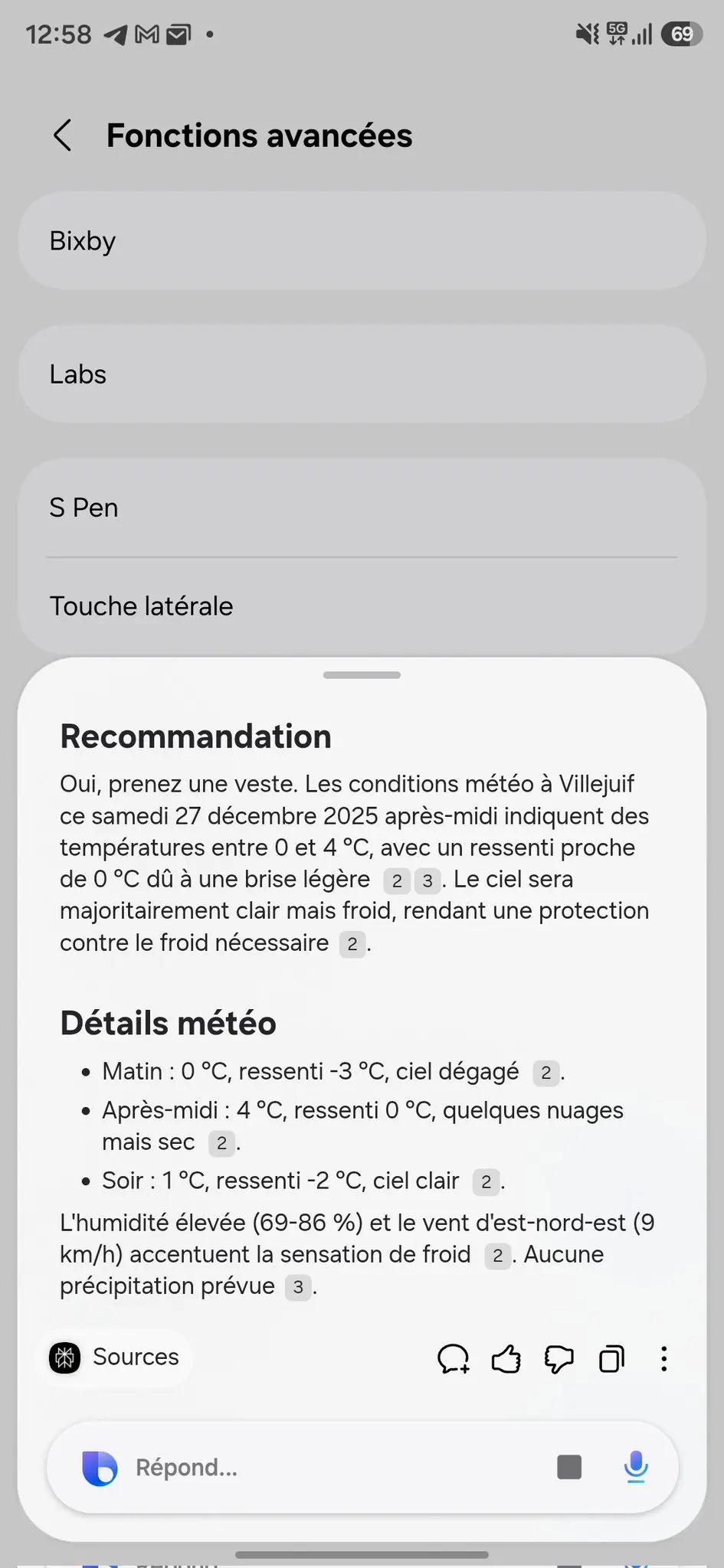
Perplexity-powered Bixby
The Perplexity-powered Bixby features a redesigned overlay that provides more detailed and contextual responses to user queries. For example, when asked about weather conditions, the enhanced assistant can offer practical recommendations like suggesting users carry a jacket, drawing on Perplexity’s real-time search engine capabilities. This integration aims to deliver richer, more current results and improve Bixby’s ability to handle complex questions.
Currently, the enhanced Bixby functionality is limited to Samsung Bixby version 4.0.50.4 and requires devices running One UI 8.5 beta, which is exclusively available for the Galaxy S25, Galaxy S25 Plus, and Galaxy S25 Ultra. Samsung already offers Perplexity’s AI search on its television products, and this capability has now been unlocked for Galaxy phones through the One UI 8.5 beta.
The full rollout is expected to debut with the Galaxy S26 series at Samsung’s launch event in February 2026, with Galaxy S26 owners being the first to experience the integration outside of beta testing. Subsequently, the Perplexity-powered Bixby will be rolled out to older Galaxy devices, including the Galaxy S25 lineup, alongside the stable One UI 8.5 update. Samsung has confirmed this timeline, though a detailed schedule and list of eligible devices may be announced during the February launch event.
Is Perplexity good as an AI Assistant?
Samsung’s Bixby, the AI-powered virtual assistant built into Galaxy devices, handles voice, text, and touch commands to perform tasks, answer questions, and control smart devices. It learns user routines to provide personalized assistance through features like Bixby Vision for object recognition and comprehensive app management, with recent updates bringing more advanced AI capabilities.
However, while AI search assistants like Perplexity excel at answering questions and providing how-to tutorials, they typically struggle with device-specific functions such as adjusting phone settings, controlling smart home devices, launching apps, opening the camera, or playing music. This limitation has been a persistent issue with Gemini AI on Google Pixel devices and across Google’s AI implementations.
Perplexity is renowned for its sophisticated search technology that delivers contextual, current information with nuanced understanding. Yet it’s not designed as a personal assistant. If Perplexity AI within Bixby remains focused on answering questions, conducting searches, and providing tutorials, the integration could work seamlessly.
The challenge lies in device control functions. For tasks like camera operation, settings adjustments, and smart device management, relying solely on Perplexity AI could result in significant performance gaps.
