
Who’s Winning the Smartphone War? Apple, Samsung, and Xiaomi Battle for Global Dominance

Subscribe for Updates
Apple, Samsung, and Xiaomi have been battling for global smartphone dominance and the results are finally here. Here’s a Quarter-by-Quarter deep dive into the World’s Best-Selling Phones!
The global smartphone market is one of the most fiercely contested arenas in consumer technology, and Counterpoint Research’s ongoing Global Smartphone Model Sales Tracker gives us one of the clearest windows into who’s winning, who’s holding steady, and who’s quietly eating everyone else’s lunch. This comprehensive breakdown covers every quarter of data available, from Q2 2023 all the way through to the latest rankings published on April 7, 2026. Buckle up — there’s a lot to unpack.
Before diving in, it’s worth understanding that the data comes from Counterpoint’s tracker and the rankings are based on sell-through data — meaning actual consumer purchases, not just units shipped to retailers. That distinction matters enormously. Shipment figures can be inflated by over-stocking; sell-through data reflects what consumers actually chose to buy. The tracker covers 99% of the global handset market with full specification analysis, making it the most comprehensive public-facing view of model-level smartphone demand available.
The top 10 best-sellers in any given quarter represent a striking concentration of market power. In the most recent quarter, for instance, just ten smartphone models accounted for 23% of all global sales. In a world of thousands of competing devices, that’s an extraordinary statistic.
The Latest Rankings: Q4 2025 / Early 2026
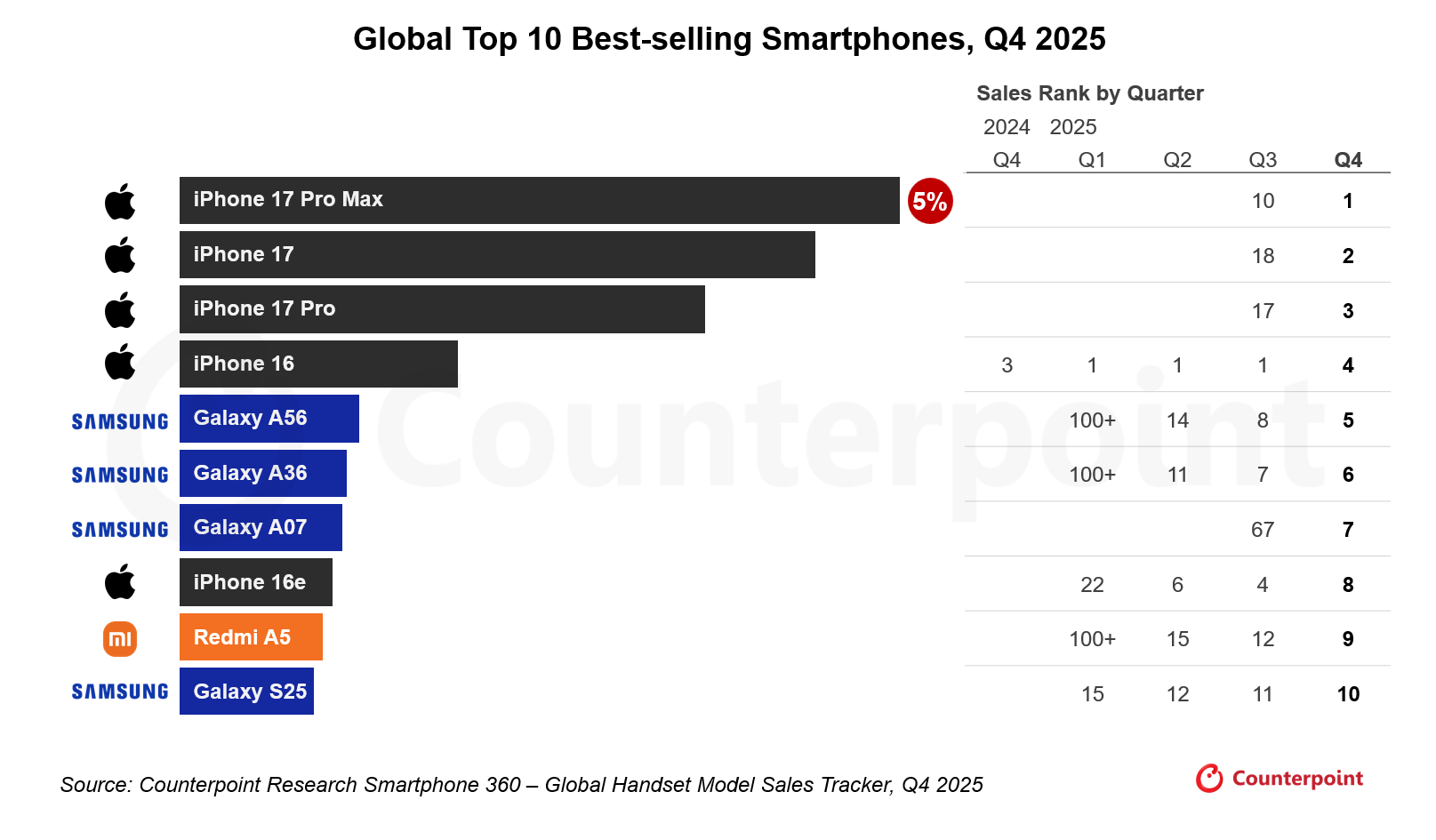
Apple emerged as the clear leader, securing five spots in the global top 10 and claiming the top three positions outright. The iPhone 17 Pro Max led global sales, followed closely by the iPhone 17 and iPhone 17 Pro. This success can largely be attributed to meaningful upgrades introduced in the iPhone 17 series, including higher refresh rate displays, increased base storage, and improved RAM configurations. These enhancements made even the base model more appealing than its predecessor, driving higher adoption rates.
Additionally, Apple continues to benefit from a strong replacement cycle, where users upgrade from older devices within the ecosystem. The company’s tightly integrated hardware and software experience remains a major draw, reinforcing brand loyalty and justifying its premium pricing strategy.
Market Highlights at a Glance
The most recently published data paints a vivid picture of current brand momentum:
- Apple: 5 spots in the global top 10
- Samsung: 4 spots
- Xiaomi: 1 spot
- The top 10 collectively represented 23% of global smartphone sales for the quarter
Apple’s iPhone 17 Series Takes the Crown
The iPhone 17 Pro Max led the entire global list — not just among iPhones, but across all brands and all price points. It was closely followed by the iPhone 17 in second place and the iPhone 17 Pro in third, giving Apple an almost unassailable grip on the podium.
What powered the standard iPhone 17 to such strong sales — notably stronger than its predecessor — were a set of targeted hardware upgrades:
- A higher display refresh rate, finally bringing the base iPhone in line with Android competitors and the Pro line
- Increased base storage, addressing one of the most common complaints about entry-level iPhones
- More RAM, improving multitasking and AI-driven features
These weren’t headline-grabbing leaps forward — but they were precisely the upgrades that had been holding back fence-sitters, and Apple’s sales figures confirm that strategy paid off handsomely.
Samsung’s Strategy: Volume Through Value
In contrast, Samsung’s success lies in its ability to scale across a broader audience, particularly through its Galaxy A series. The Galaxy A56 emerged as the best-selling Android smartphone of the quarter, followed by the Galaxy A36 and the entry-level Galaxy A07. These devices highlight Samsung’s focus on delivering strong value at competitive price points. By offering reliable performance, modern features, and wide availability, the Galaxy A series continues to resonate with consumers globally.
Samsung has also started integrating AI-driven features such as enhanced photography capabilities into its mid-range lineup, a move that significantly boosts perceived value. While the Galaxy S25 secured the tenth spot, Samsung’s flagship strategy is increasingly centered around innovation and AI capabilities, supported by targeted promotions that help sustain demand.
Samsung’s Galaxy A56 was the best-selling Android smartphone for the quarter, closely followed by the Galaxy A36 and the entry-level Galaxy A07. Wider presence and better affordability and value continue to drive sales for the Galaxy A series.
The Galaxy S25 captured the tenth spot, as the brand continues to focus on flagship smartphones and AI capabilities. Promotions in the second half further pushed the sales.
Xiaomi: Emerging Market Dominance
Xiaomi, although represented by just one device in the top 10, continues to play a crucial role in the global market. The Redmi A5 secured the ninth position, driven largely by strong sales in emerging markets such as Latin America and the Middle East and Africa. Xiaomi’s approach is rooted in affordability and scale, offering budget-friendly devices that cater to first-time smartphone users and price-sensitive consumers. Its ability to deliver functional smartphones at aggressive price points ensures continued relevance, even without a strong presence in the premium segment.
Xiaomi secured the 9th spot with the Redmi A5, showing its continued strength in price-sensitive markets.
Why Xiaomi Still Matters:
- Focus on ultra-affordable devices
- Strong presence in developing economies
- Efficient supply chain and pricing strategy
While Xiaomi lacks flagship dominance in this ranking, its ability to scale volume in emerging markets keeps it competitive.
Market Highlights
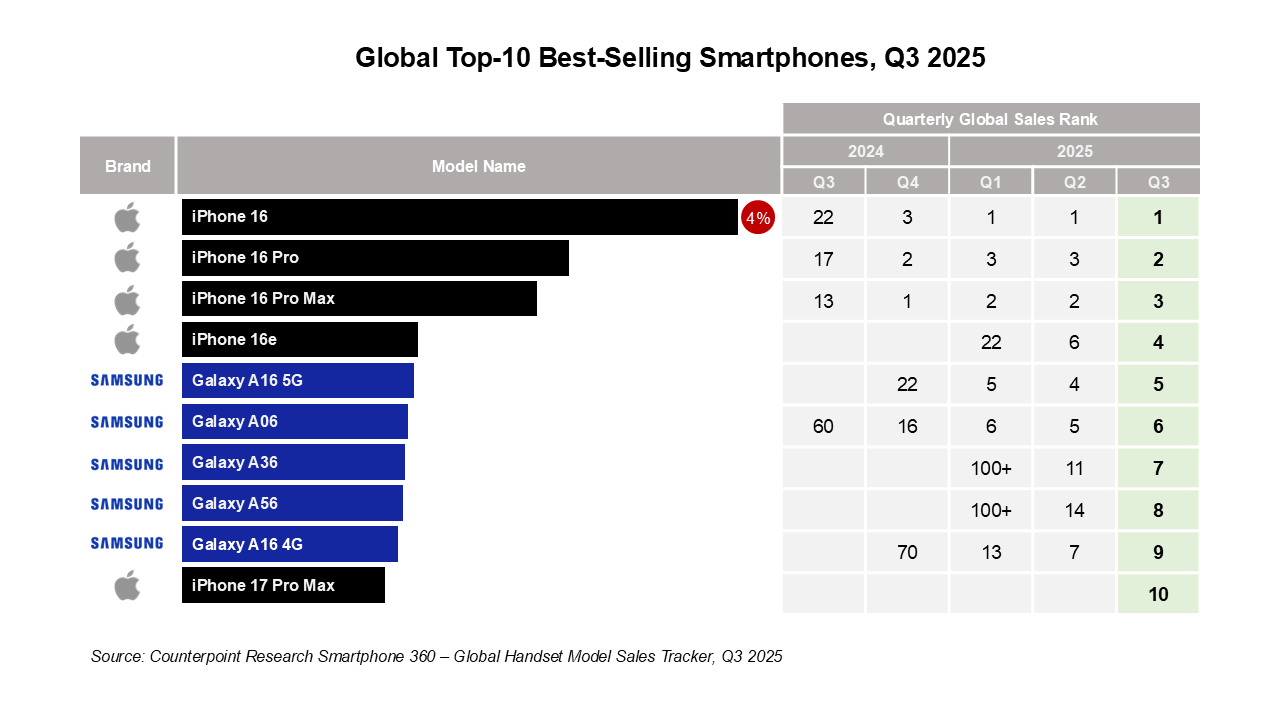
The Q3 2025 data offered a fascinating snapshot of the market at an inflection point — the iPhone 16 era was winding down as the iPhone 17 series launched:
- Apple and Samsung each captured five spots in the global top 10
- The iPhone 16 led with a 4% share of global smartphone sales, driven by notably strong performance in India and Japan
- The freshly launched iPhone 17 Pro Max entered at tenth place, already outperforming its predecessor’s comparable launch trajectory — fueled by replacement demand from users upgrading from iPhone 15 and earlier
Q2 2025 Smartphones Sales Report
By Q2 2025, the iPhone 16 had cemented itself as one of the most durable #1 best-sellers in recent memory:
- The iPhone 16 remained the world’s best-selling smartphone for the second consecutive quarter, further extending its lead over the iPhone 16 Pro and Pro Max
- A new entrant grabbed attention: the iPhone 16e broke into the top 10 for the first time, driven by strong sales in Japan and the United States — a signal that Apple’s more affordable early 2026, several durable macro-trends emerge from Counterpoint’s data:
Apple’s Structural Dominance at the Top Is Unshakeable
Quarter after quarter, an iPhone holds the #1 spot or comes extremely close to it. The transition from iPhone 15 to iPhone 16 to iPhone 17 series has been seamless in terms of sales performance,th, Galaxy A series dominance, growing AI democratization strategy, proven dual-market execution
Watch: Flagship competition from Apple remains intense; Galaxy S series needs continued differentiation to justify premium pricing
Samsung’s All-A-Series Top 10 Performance
Samsung’s Galaxy A Series Owns pricing is a formula that continues to deliver volume.
In Q3 2025, every single one of Samsung’s five entries in the top 10 came from the Galaxy A series — a remarkable statement about where the real volume sits in the Android market. The models spanned different price points, effectively targeting distinct consumer segments without cannibalizing each other.
The Galaxy A36 and Galaxy A56 both posted higher sales than their predecessors, again attributable to the infusion of Awesome Intelligence AI features. Two additional Samsung entries — the Galaxy A16 4G and Galaxy A06 — were notable as the only LTE (non-5G) smartphones in the entire global top 10. Their continued presence underlines a crucial truth about global smartphone demand: in many parts of Latin America, MEA, and other developing regions, LTE connectivity remains the standard, and 5G is still years away from mass adoption. For each of these models, emerging markets contributed over half of total sales volume.
Xiaomi
Strengths: Emerging market expertise, aggressive value-for-money positioning, strong distribution in Latin America and MEA
Watch: Thin margins and limited premium presence mean Xiaomi’s top-10 representation may remain limited to one or two spots unless it successfully moves upmarket
What Should You Buy? Consumer Takeaways From the Data
The world’s best-selling smartphones aren’t always the world’s best smartphones — but there’s often a reason they sell so well. Here’s what the data suggests for different types of buyers:
If you want the best overall experience and budget isn’t a constraint: The iPhone 17 Pro Max’s position at #1 globally is well-earned. It offers the best combination of performance, camera system, and software longevity available.
If you want a great iPhone without paying flagship prices: The standard iPhone 17’s strong Q4 showing validates it as the smart middle-ground choice — higher refresh rate, more storage, more RAM, at a lower price than the Pro variants.
If you’re an Android user who wants flagship AI features at a reasonable price: The Samsung Galaxy A56 and Galaxy A36 are the data-backed answers. Both now include AI features previously reserved for the S series, at a fraction of the S25’s price.
If budget is your primary concern: The Galaxy A07 and Xiaomi Redmi A5 represent the world’s most popular budget smartphones for good reason — they’re reliable, well-supported, and available at prices that make smartphone ownership accessible globally.
Looking Ahead: What Will Define the Next Few Quarters?
Based on the trajectory visible in Counterpoint’s multi-year dataset, several developments are worth watching:
- Apple’s AI roadmap: How deeply Apple integrates on-device AI into the iPhone 17 standard model could determine whether it sustains or extends its #1 position
- Samsung’s mid-range AI evolution: The A57 and A37 (or whatever next-generation A-series models follow) will need to keep pace with rapidly evolving consumer AI expectations
- Xiaomi’s premium ambitions: The brand has signaled interest in competing more aggressively in the $400–$700 segment; success there could mean more than one Xiaomi model in future top-10 lists
- Emerging market 5G adoption: As 5G infrastructure rolls out across Latin America and Africa, the LTE-only entries in the top 10 will gradually give way to 5G successors — a transition that will reshape both device specs and pricing dynamics

